
Table of Contents
About String Hopper Kottu
String Hopper Kottu, known as "Indi Appa Kottu" or "Idiyappam Kottu" in Sinhala, is a distinctive variation of kottu that replaces the traditional godamba roti with string hoppers - delicate, steamed nests of rice flour noodles that are a staple in Sri Lankan cuisine. While roti-based kottu has a chewy, bread-like texture, string hopper kottu is lighter, more noodle-like, and has a completely different mouthfeel that many Sri Lankans actually prefer.
String hoppers (idiyappam) are one of Sri Lanka's most ancient foods, made by pressing a rice flour dough through a special mold to create thin, vermicelli-like strands that are then steamed in circular nests. They are traditionally eaten for breakfast or dinner with coconut milk curry (kiri hodi) or dhal. The innovation of turning leftover string hoppers into kottu likely originated in Tamil households in the north and east of Sri Lanka, where idiyappam is a daily staple and leftovers are common.
The technique for making string hopper kottu differs from regular kottu in one important way: you must be gentler. While roti kottu involves aggressive chopping with metal blades, string hoppers are more delicate and will disintegrate into mush if handled too roughly. The correct technique is to toss and fold rather than chop, allowing the string hopper strands to separate naturally and absorb the curry sauce while maintaining their noodle-like identity. When done properly, each strand is coated with spicy, savory sauce, intertwined with vegetables and protein, creating a dish that resembles a Sri Lankan-style stir-fried noodle masterpiece.
Ingredients
Base
- 12 string hoppers (idiyappam), broken into rough pieces by hand
- 2 tablespoons coconut oil or vegetable oil
Protein (choose one)
- Option A - Chicken: 200g boneless chicken thigh, cooked in curry and shredded, plus 1/2 cup curry sauce
- Option B - Egg: 4 large eggs, lightly beaten
- Option C - Mixed: 150g cooked chicken plus 2 eggs
Vegetables
- 1 large onion, finely sliced
- 2 leeks, washed and sliced into thin rings
- 1 medium carrot, julienned into thin matchsticks
- 1/2 cup green cabbage, finely shredded
- 3 green chilies, sliced lengthwise
Aromatics and Spices
- 4 cloves garlic, minced
- 1 inch piece ginger, finely minced
- 10 fresh curry leaves
- 1 small piece pandan leaf (rampe)
- 2 tablespoons Sri Lankan roasted curry powder
- 1 teaspoon chili flakes (adjust to taste)
- 1/2 teaspoon turmeric powder
- 1 tablespoon soy sauce
- 1/2 cup thick coconut milk or curry sauce
- 1 teaspoon dried Maldive fish flakes (umbalakada, optional)
- Salt and freshly ground black pepper to taste
- Fresh coriander (cilantro) leaves for garnish
Step-by-Step Instructions
Step 1: Prepare the String Hoppers
Take the string hoppers and break them into rough pieces by hand. Do not crush or crumble them - you want to maintain the individual noodle strands as much as possible. Simply break each circular string hopper nest into 3-4 irregular pieces. If using freshly steamed string hoppers, let them cool to room temperature first, or better yet, use leftover string hoppers from the previous meal. Slightly dried-out string hoppers actually work better for kottu as they hold their shape during stir-frying and absorb sauce more readily without becoming mushy.
Step 2: Prepare the Protein
If using chicken, cook it in a small pot with coconut milk, curry powder, turmeric, curry leaves, pandan leaf, onion, garlic, and salt. Simmer for 18-20 minutes until tender. Shred the chicken and reserve the thick curry sauce. If using eggs, beat them lightly in a bowl with a pinch of salt and turmeric. If using both, prepare the chicken curry and beat the eggs separately.
Step 3: Heat the Wok
Place a large wok or heavy-bottomed pan over high heat. Add the coconut oil and let it heat until shimmering. Coconut oil is particularly good for string hopper kottu as its subtle sweetness complements the rice flour noodles beautifully.
Step 4: Cook the Aromatics
Add the curry leaves and pandan leaf pieces - they will crackle and pop. Quickly add the sliced green chilies, minced garlic, and minced ginger. If using Maldive fish flakes, add them now too. Stir-fry for 20-30 seconds until the oil is infused with fragrance. The Maldive fish will toast slightly and release a wonderful umami aroma.
Step 5: Stir-Fry the Vegetables
Add the sliced onions and leeks. Toss on high heat for about 2 minutes until they soften and the edges begin to caramelize. Add the julienned carrots and shredded cabbage. Stir-fry for another 1-2 minutes. The vegetables should be just softened but still have a pleasant crunch. They provide essential texture contrast to the soft string hoppers.
Step 6: Add the Eggs
Push the vegetables to one side. Pour the beaten eggs (whether using egg-only or mixed version) into the empty space. Let them set for 10-15 seconds, then break them into large, rough pieces and fold them through the vegetables. Keep the egg chunky rather than finely scrambled.
Step 7: Add the String Hoppers (The Gentle Step)
Add all the broken string hopper pieces to the wok. This is where the technique differs crucially from roti kottu. Instead of the aggressive chopping motion used for roti, use a gentle tossing and folding action. Use two spatulas to lift, turn, and fold the string hoppers through the vegetable and egg mixture. The goal is to separate the string hopper strands while mixing them with the other ingredients without crushing them into paste. Think of it like tossing a salad rather than chopping on a board.
Step 8: Add Sauce and Seasoning
If using chicken, add the shredded chicken pieces now. Pour the curry sauce (or coconut milk) over the mixture. Sprinkle with curry powder, chili flakes, turmeric, and soy sauce. Continue the gentle tossing and folding for 2-3 minutes. The string hopper strands will absorb the curry sauce and turn a beautiful golden color. Each strand should be individually coated with the spiced sauce.
Step 9: Final Check and Serve
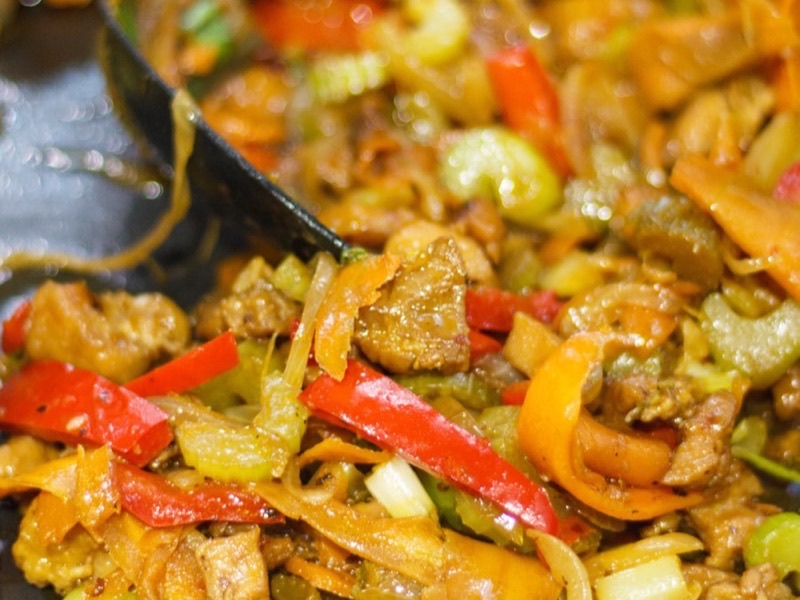
Taste and adjust seasoning with salt and black pepper. The finished string hopper kottu should look like a tangled nest of spiced noodles interspersed with vegetables, egg, and protein. It should be moist and flavorful but not soggy or wet. The individual string hopper strands should be visible and distinct. Transfer to a warm plate, garnish with fresh coriander leaves, and serve immediately.
Tips & Tricks for Perfect String Hopper Kottu
- Be gentle: The single most important tip. String hoppers are delicate rice flour noodles, not sturdy wheat roti. Toss and fold - never chop aggressively. If you hear the clanging of metal spatulas hitting the pan like regular kottu, you are being too rough.
- Use leftover string hoppers: Freshly steamed string hoppers are too soft and moist for kottu. Day-old or leftover string hoppers that have dried slightly are ideal - they hold their shape and absorb sauce without disintegrating.
- Red vs white string hoppers: White string hoppers are made from white rice flour and are the most common. Red string hoppers, made from red rice (kuruluthuda) flour, have a nuttier flavor and slightly firmer texture that works exceptionally well for kottu. If you can find them, try red string hoppers for a more robust version.
- Do not overcrowd: If making a large batch, cook in two rounds. Overcrowding leads to steaming rather than stir-frying, which makes string hoppers mushy.
- Maldive fish is key: The umami from dried Maldive fish flakes is particularly important in string hopper kottu because the rice flour noodles are more neutral in flavor than wheat roti and benefit from the extra savory depth.
- Coconut milk, not water: Always use coconut milk or curry sauce for moisture, never water. Water will make the string hoppers gummy and flavorless.
- Serve immediately: String hopper kottu does not hold well. The noodles continue to absorb moisture and can become soggy within 10-15 minutes. Serve and eat right away.
Nutrition Information
Per serving with chicken (approximate values):
| Nutrient | Amount |
|---|---|
| Calories | 440 kcal |
| Protein | 24g |
| Carbohydrates | 52g |
| Fat | 16g |
| Saturated Fat | 7g |
| Fiber | 3g |
| Sodium | 560mg |
| Iron | 15% DV |
Serve With
- Kiri hodi: Coconut milk gravy is the traditional companion for string hoppers and works beautifully with string hopper kottu too.
- Chicken or dhal curry: Extra curry sauce for drizzling adds richness and moisture.
- Lunu miris: The punchy chili and onion sambol is essential for extra heat.
- Pol sambol: Freshly made coconut sambol for crunch and tropical flavor.
- Seeni sambol: Sweet caramelized onion relish provides a lovely contrast.
- Fresh lime: A squeeze of lime brightens the dish wonderfully.
Frequently Asked Questions
String hoppers (idiyappam) can be found in the frozen section of Sri Lankan, South Indian, or Asian grocery stores. They are sold frozen in packets and can be steamed directly from frozen according to package directions. Some stores also sell fresh string hoppers daily, particularly in areas with large Sri Lankan communities. If you cannot find string hoppers at all, you can substitute with thin rice vermicelli (rice stick noodles) - cook them according to package directions, drain, and use them the same way. The texture will be slightly different but the flavor profile will be similar.
Yes, string hopper kottu is naturally gluten-free since string hoppers are made from rice flour and water, with no wheat involved. This makes it an excellent option for people with celiac disease or gluten sensitivity who want to enjoy kottu. However, be mindful of the soy sauce - standard soy sauce contains wheat. Use tamari (gluten-free soy sauce) instead. Also check your curry powder blend to ensure it does not contain any wheat-based fillers. With these small adjustments, string hopper kottu is a completely gluten-free meal.
The main differences are in texture, cooking technique, and base ingredient. Regular kottu uses godamba roti (wheat flatbread) which is chewy and bread-like, while string hopper kottu uses idiyappam (rice flour noodles) which is lighter and more delicate. The cooking technique also differs: roti kottu involves aggressive chopping with metal blades, while string hopper kottu requires gentle tossing and folding. String hopper kottu is also naturally gluten-free since it uses rice flour. In terms of flavor, string hopper kottu tends to absorb more sauce, resulting in a more intensely flavored but softer-textured dish. Many Sri Lankans consider string hopper kottu to be a more refined and lighter alternative to the heavier roti version.
Advertisement